Great Sphinx of Giza
Plan your visit to the Great Sphinx of Giza with this guide to its history, location, tickets, best viewpoints, the missing nose and how to combine it with the pyramids.
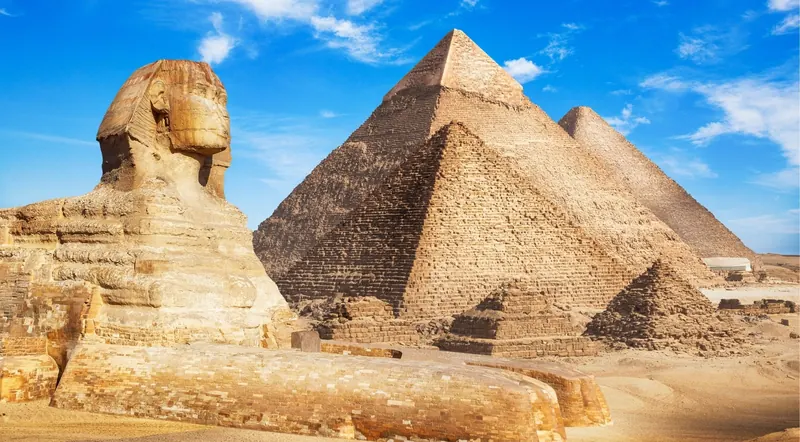
The Great Sphinx of Giza is one of the most recognisable monuments on Earth.
With the body of a lion and the head of a human king, the enormous limestone figure has stood beside the Giza Pyramids for around 4,500 years.
Yet the Sphinx is easy to underestimate when planning a visit. Most travellers focus on the three pyramids, particularly the Great Pyramid of Khufu. But the Sphinx is not an extra photo stop beside them. It belongs to the ancient landscape of the Pyramid Complex of Khafre and is one of the most important surviving monuments of Egypt’s Old Kingdom.
If you are visiting Giza on a Cairo day trip from Sharm El Sheikh, make sure your itinerary leaves enough time to walk the Sphinx area properly instead of seeing it through the coach window on the way out.
Great Sphinx of Giza at a Glance
| Location | Giza Plateau, Giza |
| Date | Fourth Dynasty, around the 26th century BC |
| Usually associated with | Pharaoh Khafre |
| Material | Limestone |
| Length | About 73 metres |
| Height | About 20 metres |
| Form | Human head and lion’s body |
| Faces | East |
| Nearby pyramid | Pyramid of Khafre |
| Standard viewing | Included within a Giza Plateau visit |
| Recommended time | Around 30–60 minutes |
| Best combined with | Giza Pyramids and Grand Egyptian Museum |
Visitor information was last checked in August 2026. Opening hours, ticket prices and access arrangements can change.
Most Sharm El Sheikh day trips pair the Sphinx with the Pyramids of Giza, the Grand Egyptian Museum or the Egyptian Museum in Tahrir Square, and some add Khan el-Khalili bazaar or a Nile felucca ride. These are other Cairo experiences you can book from the Red Sea coast:
What Is the Great Sphinx of Giza?
The Great Sphinx is a gigantic sculpture carved mainly from the natural limestone bedrock of the Giza Plateau.
It shows a reclining lion with the head of a human king. In ancient Egyptian art, the body of a lion combined with the image of a pharaoh expressed royal power and strength.
The monument measures approximately:
- 73 metres long
- 20 metres high
- about 19 metres wide
That makes it one of the largest monumental sculptures surviving from the ancient world.
How Old Is the Great Sphinx?
The Sphinx was created during Egypt’s Fourth Dynasty, the same dynasty that built the major pyramids at Giza.
That places it roughly 4,500 years ago.
Around it stood Khufu’s Great Pyramid, Khafre’s Pyramid, Menkaure’s Pyramid, temples, causeways, tombs and royal cemeteries. The Sphinx was one part of this sacred landscape.
Who Built the Great Sphinx?
The strongest archaeological evidence links the Sphinx to the reign of Pharaoh Khafre.
Khafre was the son of Khufu, the king for whom the Great Pyramid was built, and he built the second-largest pyramid at Giza.
The Sphinx stands beside Khafre’s Valley Temple, near the lower end of the causeway that leads up to his pyramid complex. Archaeologists have also noted similarities between the Sphinx’s face and surviving statues of Khafre.
For these reasons, the conventional view is that the monument was made during Khafre’s reign, around 2558–2532 BC.
Is the Sphinx Supposed to Be Khafre?
Probably.
The human face is generally read as Pharaoh Khafre. Egyptian sphinxes often showed a king with human royal features, a lion’s body and a royal headdress.
No surviving inscription from the original construction says outright that the monument is Khafre, though. That is why the identification is usually described as strongly supported, not proven.
What Does the Great Sphinx Represent?
The Sphinx combines two powerful symbols.
The lion
Lions stood for strength, dominance and royal power.
The king
The human head identifies the figure with Egyptian kingship.
Together, they present the ruler as an immensely powerful, guardian-like figure.
Centuries later, Egyptians also associated the Sphinx with the sun god and called it Horemakhet, meaning “Horus in the Horizon.” Its eastward orientation towards the rising sun strengthened that solar connection.
Does the Sphinx Face the Pyramids?
No.
The Great Sphinx faces approximately east, towards the rising sun. The pyramids rise behind it, to the west.
That layout is what gives Giza one of its classic photographs: the Sphinx in the foreground with a pyramid behind it.
Why Is the Sphinx Near Khafre’s Pyramid?
The Sphinx sits within the layout of Khafre’s pyramid complex.
Immediately beside it are:
- Khafre’s Valley Temple
- the Sphinx Temple
- the lower section of Khafre’s causeway
The causeway once connected the valley area with the mortuary temple beside Khafre’s pyramid. This physical relationship is one of the strongest pieces of evidence tying the Sphinx to Khafre.
How Was the Great Sphinx Made?
The Giza Pyramids were built from enormous quantities of quarried stone blocks. The basic form of the Sphinx, by contrast, was carved directly from the natural bedrock.
Workers cut away the rock around a limestone outcrop and shaped what remained into the lion’s body and human head.
Over thousands of years, parts of the monument deteriorated and needed restoration. Some of what you see today is masonry added during different periods of conservation and repair.
What Happened to the Sphinx’s Nose?
The missing nose has produced one of the most persistent myths about Giza.
According to the popular story, Napoleon’s soldiers shot the nose off with cannon fire during the French campaign in Egypt.
That story is false. European drawings show the Sphinx without its nose before Napoleon arrived in Egypt in 1798.
A medieval Egyptian account blames deliberate damage on a man named Muhammad Sa’im al-Dahr in the 14th century, although the precise circumstances are still debated.
What can be said with confidence is that Napoleon’s troops did not cause the original loss of the Sphinx’s nose.
Did the Sphinx Originally Have a Beard?
The Sphinx appears to have had a ceremonial beard during part of its history. Fragments associated with the beard survive in museum collections.
When it was added, and what the monument looked like in different periods, are more complicated questions.
Was the Sphinx Originally Painted?
Probably.
Ancient Egyptian sculpture was often brightly painted. Traces of pigment found on and around the Sphinx suggest parts of it were once coloured, including red pigment on the face.
The ancient Sphinx would have looked quite different from the weathered limestone figure you see today.
Was the Sphinx Ever Buried in Sand?
Yes.
For long stretches of its history, windblown sand piled up around the Sphinx. At times much of the body was buried while the head stayed visible.
The most famous episode comes from Egypt’s Eighteenth Dynasty, more than a thousand years after the Sphinx was carved.
According to the inscription on the Dream Stela, the young prince who later became Thutmose IV rested near the half-buried Sphinx. In a dream, the Sphinx promised him the throne if he cleared away the sand around it.
What Is the Dream Stela?
The Dream Stela of Thutmose IV stands between the front paws of the Sphinx.
It was set up during the New Kingdom and tells how Prince Thutmose rested beside the Sphinx while out hunting. The Sphinx appeared to him in a dream and promised he would become king if he cleared the sand covering the monument.
The inscription shows something important: the Sphinx was already ancient and sacred to Egyptians living more than a thousand years after Khafre.
Is There a Temple in Front of the Sphinx?
Yes.
The Sphinx Temple sits immediately in front of the monument, and Khafre’s Valley Temple is right next to it.
Both are easy to overlook because most visitors concentrate on the pyramids and the Sphinx itself.
Can You Walk Up to the Great Sphinx?
Ordinary visitors cannot walk freely around the Sphinx’s body or stand directly between its paws.
The monument sits inside a protected archaeological enclosure. Visitors see it from designated viewing areas around the Sphinx and the temple complex.
Can You Go Inside the Sphinx?
No standard visitor route takes you inside the Great Sphinx.
Stories about tunnels, chambers and secret passages beneath the monument have nothing to do with an ordinary visit.
If you want a monument at Giza that you can enter, the Great Pyramid of Khufu and certain other pyramids are the ones to look at.
Great Sphinx Tickets
For an ordinary visit, the Sphinx is part of your wider visit to the Giza Plateau archaeological area.
As of August 2026, the official Giza Plateau admission price for foreign visitors is:
| Ticket | Price |
|---|---|
| Foreign adult | EGP 700 |
| Foreign student | EGP 350 |
You do not normally buy a separate ticket just to see the Sphinx from the standard viewing areas. Our Giza Pyramids visitor guide covers the separate interior tickets.
Great Sphinx Opening Hours
The Sphinx is part of the wider Giza Plateau visit.
As of August 2026, Egypt’s Ministry of Tourism and Antiquities lists general Giza Plateau opening hours as:
8:00 AM–4:00 PM daily
Hours may change seasonally, during Ramadan or for operational reasons.
How Long Do You Need at the Great Sphinx?
Allow approximately 30–60 minutes for the Sphinx area.
Thirty minutes is enough to reach the main viewing area, see the Sphinx up close, take photographs and look at the temples beside it.
An hour lets you take it in without rushing.
Where Is the Best View of the Sphinx?
The visitor area around the Sphinx and Valley Temple gives the classic close-up views.
Look for three angles:
Front/three-quarter view
This gives you the clearest picture of the human face, the lion’s body and the outstretched paws.
Sphinx with Khafre’s Pyramid
One of the classic Giza compositions puts the Sphinx in the foreground with Khafre’s Pyramid behind it.
Side view
From the side, the full length of the lion’s body is much easier to appreciate.
Great Sphinx vs Giza Pyramids
You do not need to choose between them. They are part of the same archaeological visit.
A good first-time Giza itinerary includes:
- Great Pyramid of Khufu
- Pyramid of Khafre
- Pyramid of Menkaure
- panoramic pyramid viewpoint
- Great Sphinx
- Valley Temple area
Great Sphinx and Grand Egyptian Museum
The Grand Egyptian Museum is close to the Giza Plateau.
That makes it easy to combine:
Giza Pyramids + Great Sphinx + Grand Egyptian Museum
in one day.
Visiting the Sphinx From Sharm El Sheikh
The Great Sphinx is normally one of the main stops on a Cairo and Pyramids day trip from Sharm El Sheikh.
Day trips from Sharm pair it with the three major pyramids; the Sphinx is not sold as a separate excursion.
The main ways to reach Cairo from Sharm are by plane or bus, and our plane vs bus comparison sets out the time and cost of each. The Cairo, Pyramids, Sphinx & GEM day trip by bus (from $92, rated 4.9 from 1,325 reviews) is the budget option. The Cairo day trip by flight with the Pyramids & GEM (from $293, rated 4.9 from 537 reviews) cuts the travel to under an hour each way.
Whichever you choose, make sure the tour includes actual time at the Sphinx viewing area.
Compare Cairo day trips from Sharm El Sheikh →
Frequently Asked Questions
Where is the Great Sphinx of Giza?
On the Giza Plateau, near the eastern end of Khafre’s pyramid complex.
How old is it?
Approximately 4,500 years old.
Who built it?
The strongest archaeological evidence links it to Pharaoh Khafre.
Whose face is on the Sphinx?
The face is generally identified as Khafre’s, although the identification is not completely certain.
How big is it?
Approximately 73 metres long and 20 metres high.
Why does the Sphinx have a lion’s body?
The lion stood for power and strength, while the human head stood for royal authority.
What happened to its nose?
The exact circumstances are uncertain, but the nose was already missing before Napoleon’s campaign in Egypt.
Does the Sphinx face the pyramids?
No. It faces east.
Can you go inside?
There is no standard visitor route inside the monument.
Do you need a separate ticket?
No. Standard viewing is part of a general Giza Plateau visit.
Final Thoughts
The Great Sphinx of Giza deserves more than a quick photograph.
It is one of the oldest monumental sculptures surviving from ancient Egypt, carved straight out of the limestone plateau in the age of the pyramid builders.
Knowing its connection with Khafre, his Valley Temple and the wider pyramid complex makes the Sphinx far more interesting than the familiar image you have seen countless times before arriving.
If you are travelling from the Red Sea coast, make sure your Cairo day trip from Sharm El Sheikh gives you time not only for the pyramids but also to explore the Sphinx area properly.
Cairo Awaits — Book Your Day Trip From Sharm El Sheikh
Join 1,300+ travelers who rated this Cairo day trip 4.9/5. Round-trip transport, an Egyptologist guide, lunch, and entrance fees — all included. Free cancellation.
Check Availability & Book